What are they?
Imagine the ocean running a fever for months on end.
Sounds bad right?
That is essentially what a marine heatwave is – the ocean equivalent of a heatwave on land.
Marine Heatwave (MHW) events occur when ocean temperatures rise significantly above the long-term average for an area, with the technical definition exceeding the 90th percentile for 5 consecutive days.
- The above definition implies that the threshold temperature will change in response to climate change, so that in theory, they still remain a ‘rare’ occurrence.
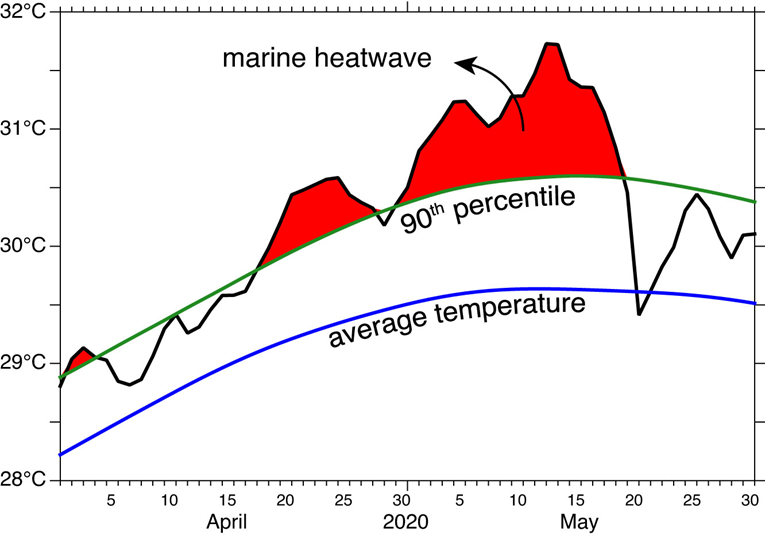
Example of a Marine Heatwave in the Bay of Bengal in 2020. 85% of the corals in the Gulf of Mannar near the Tamil Nadu coast where bleached following this event.
What causes a Marine Heatwave event?
Marine Heatwaves are caused by a range of ocean processes, from ENSO/climate modes to long-term warming trends. They may act separately or in combination with each other, but there are two main drivers that are attributed to most marine heatwave events that have occurred in recent decades:
- Surface heat flux – this is where the surface is heated by shortwave solar radiation, some of which is absorbed, but a portion of it is reflected back upwards in a longer waveform of radiation. The atmosphere above is heated through conduction and convection. High-pressure patterns that become “stuck” over land or sea for a prolonged time period are common culprits. MHW’s caused by surface heat flux are usually short-to-moderate in duration.
- Advection – where ocean currents drive warmer seas towards a cooler seas and modify the environment in that cooler region to become less cold. Advection only occurs so long as there is a source (i.e. a direct current from point A (warmer) to point B (far colder). MHW’s driven by advection are usually longer in duration, than ones started via surface heat flux.
Oceanic mixing processes play a key role in their intensity, occurrence, and duration. What this means is that Marine Heatwaves can start via surface heat flux, only for slight advection into a region of warmer waters to offset the marine heatwave through enhanced convection, commonly causing an area of high-pressure to trap low-level marine cloud. The affect this would have is reflecting most of the Sun’s energy out to space and bringing about a net cooling, thus ending the Marine Heatwave.
Info from: Marine Heatwaves | National Oceanography Centre
Why Should We Care About Them?
On a global scale:
In all regions of the globe, Marine Heatwaves cause undue stress on coral reefs and mangroves, through stress from excess heat, harmful algal blooms or enhanced disease spread. In turn, this reduces the biodiversity of our oceans around tropical regions. Consequently, species such as Whales and Turtles may also be displaced and trapped on beaches.
Furthermore, the reduction of biodiverse coral and mangrove areas decreases the number of carbon sinks. This continues to destabilise CO2 concentrations in the atmosphere.
In polar regions by contrast, marine heatwaves – particularly during the boreal summer leads to more dramatic reductions in Arctic sea ice. The effects of MHW events during the Autumn and Spring stunt the recovery of Arctic sea ice, no doubt reinforcing that MHW’s contribute to the rising seas globally which are, less biodiverse and more polluted.
The other way in which Marine heatwaves lead to rising sea levels is the mechanism whereby water physically expands as it warms.
Prolonged marine heatwaves interact with the Earth’s atmosphere and alter weather systems and regimes, such as the ENSO (El Niño-Southern Oscillation) in the Pacific, and the NAO (North Atlantic Oscillation), contributing to weather extremes including longer heatwaves, droughts, intense storms and flooding.
Surrounding the British Isles:
Around the British Isles, the increased frequency of marine heatwaves has already brought about a change in the behaviour of marine wildlife surrounding the UK’s waters, with fewer cold fish species (Cod, Haddock, Salmon and Bream) on average throughout the year and more fish such as Mackerel, Sardines and Hake. “While species like Salmon are projected to suffer from marine heatwaves, others, like bluefin tuna, sea bass, squid, jellyfish, and stingrays may thrive and increase in population”.
During Marine Heatwave Events, namely June 2023 (see below) and July 2025, land heatwaves can be amplified as the cooling effect of sea breezes is reduced. Under the right atmospheric conditions, MHW’s may fuel extreme rainfall events too.
(July 2025 Marine Heatwave mentioned: https://www.metoffice.gov.uk/blog/2025/waters-surrounding-uk-experiencing-marine-heatwave | purple text above paraphrases a section from the Impacts & Risks section in the article)
June 2023 UK Marine Heatwave:
In June 2023, SSTs soared in the Northwestern European Atlantic Shelf. This prompted The National Oceanic and Atmospheric Administration (NOAA) to declare a category 4 marine heatwave in waters surrounding the UK on the 17th June.
The average over the whole region was +2.9°C and temperatures this warm persisted for 16 days. Locally, around coastal regions of Ireland and in the North Sea, in the peak week of the 19-26 June, SSTs locally showed +5°C anomalies. These local peaks were confirmed by gliders, recording near-surface temperatures of over 16°C in the Rockall Trough (Berthou et al.), as figure 1.1 shows in diagram a).
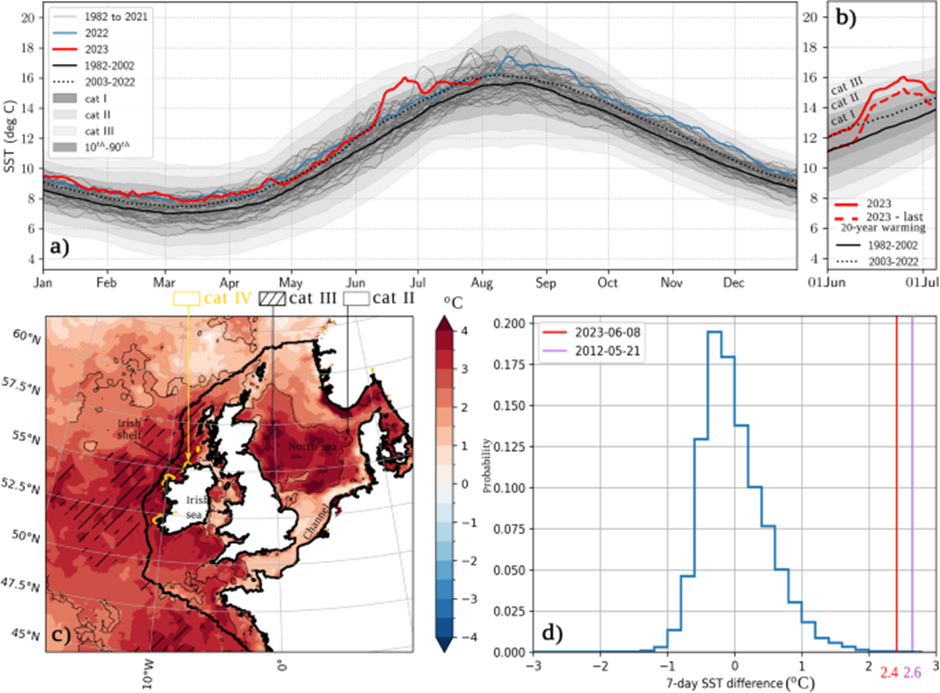
Figure 1.1 June 2023 marine heatwave characteristics from long-record satellite-based sea surface temperature datasets. (from https://www.nature.com/articles/s43247-024-01413-8)
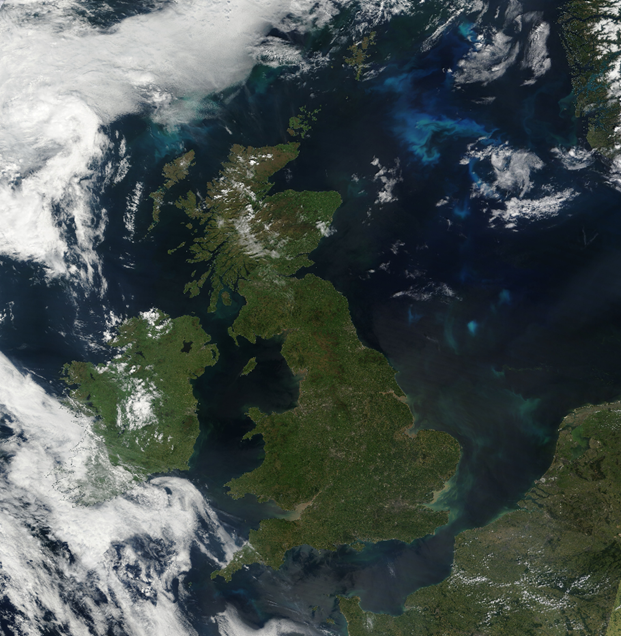
Figure 2: Changes in biochemical composition in the North Sea – Source Nasa Worldview, date 14/06/2023, https://wvs.earthdata.nasa.gov/api/v1/snapshot?REQUEST=GetSnapshot&TIME=2023-06-14T00:00:00Z&BBOX=48.9141,-11.9899,61.4572,6.5435&CRS=EPSG:4326&LAYERS=MODIS_Terra_CorrectedReflectance_TrueColor,Coastlines_15m&WRAP=day,x&FORMAT=image/png&WIDTH=4217&HEIGHT=2854&colormaps=,&ts=1765120375688
The significance of marine heatwave around the summer solstice affected the weather in June, with it being notably, hotter, more humid and sunnier, as shown by the Met Office CET. This is likely due to the reduced cooling effect of the sea breeze. Note in figure 2 the lighter blue colour in the North Sea off the North East Coast of Scotland / South West coast of Norway.
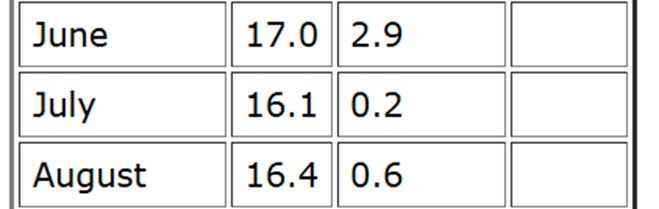
Data from: https://www.metoffice.gov.uk/hadobs/hadcet/cet_info_mean2023.html
Climate Implications on Marine Heatwaves
The IPCC AR6 report (2021) says that it is ‘virtually certain that hot extremes, including Marine Heatwaves’ have approximately doubled in frequency since the 1980s (high confidence), with most marine heatwave events since 2006 being anthropogenically contributed to’.
What this means, is that scientists working in this field are in strong agreement that the background warming of the climate system is making marine heatwaves more frequent, temperature extremes becoming greater and marine heatwaves becoming prolonged. These effects are part of a feedback loop of anthropogenic climate change; with warmer oceans, there is more fuel for tropical storms and hurricanes (see Hurricane Melissa, which hit Jamaica in October 2025).
Spatial Extent of Marine Heatwaves
Marine Heatwaves (MHW’s) also have a growing spatial extent.
- A spatial extent is how a large area of the ocean is affected by abnormally warm sea-surface temperatures at the same time.
In other words, it is the geographical coverage of such warm ocean conditions (say from the British Isles to Canada or the Azores to Iceland).
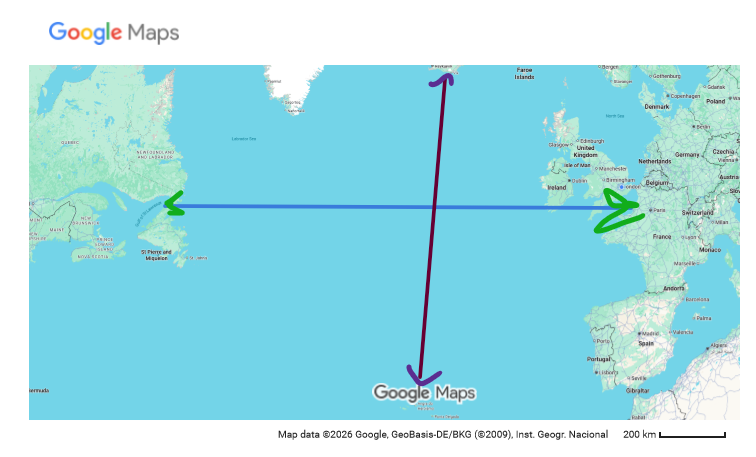
Figure 3: Overlay of Google Maps Image illustrating the Spatial Extent of a Marine Heatwave *this particular marine heatwave would be rather substantial, stretching from UK(right), to Canada(left) and Iceland (top) to Azores (bottom). https://www.google.com/maps/@50.9845067,-30.1957299,5z?entry=ttu&g_ep=EgoyMDI2MDEwNy4wIKXMDSoKLDEwMDc5MjA3M0gBUAM%3D
Marine Heatwaves with a large spatial extent create multi-regional anomalies, which when on a scale of the 2023 North Atlantic Marine Heatwave, are large enough to influence humidity levels and atmospheric circulation feeding into Western Europe.
Why should we monitor the spatial extent of marine heatwaves?
Monitoring the spatial extent of marine heatwaves is critical because the size of an event determines how far-reaching its impacts can be. Large, basin-scale heatwaves can disrupt weather patterns, alter the transport of atmospheric moisture, and influence the development of high-pressure systems in ways that smaller, localised anomalies cannot. They also affect entire ecosystems, shifting species distributions and stressing fisheries across wide regions rather than just isolated coastlines.
By tracking how far these warm anomalies spread, scientists can better anticipate long-term patterns, thereby releasing more accurate seasonal forecasts.
Tracking systems will also help by serving as an early warning sign of increased likelihood of storm development, or high humidity, where a wet-bulb heatwave affecting land is far more deadly than a dry-bulb heatwave. Furthermore, it also permits scientists to keep tabs on broader climate implications, determining if an ocean is warming faster and more persistently than modelled.
- Wet-bulb heatwave: Heatwaves with high humidity. Often cause the worst impacts to NW Europe and North America during the Boreal Summer months.
- Dry-bulb heatwave: The dry air desert heatwaves – conditions feel less oppressive than a wet-bulb heatwave.
What measures can we take to reduce the rapid intensification and frequency of MHWs?
- Reduce greenhouse gas emissions (GHG’s): This is the most critical action, given that the IPCC AR6 report remarks MHWs having doubled in frequency since the 1980s due to anthropogenic climate change (high confidence).
Addressing the root cause means:
- Transitioning to renewable energy sources.
- Improving energy efficiency across industries.
- Reducing deforestation and protecting climate sinks (including ocean ecosystems).
- Protect the ocean carbon sinks – As aforementioned, coral and mangrove die-off due to warming ocean temperatures and an rise in the number of MHW events reduces natural carbon absorption. To mitigate this it would be amazing if:
- Efforts are made to restore and conserve surviving coastal ecosystems (mangroves, seagrass beds, salt marshes).
- Establish and expand marine protected areas.
- Reduce other local stressors on coral reefs (pollution, overfishing, coastal development).
- Adaptation and Resilience Measures
- Bolster monitoring and early warning systems – satellite monitoring, ocean sensors and gliders, as well as creating models that are better and predicting marine heatwave onset and duration.
- Adaptive management for fisheries – concerning shifts around UK waters, if flexible fishing quotas that respond to changing distributions were established, and support is provided to fishing communities to adapt to new species compositions.
The Reality
However, it is important to be honest:
We can’t directly stop marine heatwaves in the short term. Thermal inertia means that ocean warming will continue for many decades to come. Even if emissions were dramatically cut overnight, some additional warming and increased marine heatwave frequency is already locked in.
The key is reducing the ultimate intensity and frequency through long-term climate action while building resilience to cope with the events that are now unavoidable.